

Welcome to a shockingly non-tech article on this blog. It is the first, but will not be the last, and I invite you to follow through. You need not agree (you might even find yourself in massive disagreement), but all I ask you to is to make up your own mind and spend a few minutes in your own thought-world to take your stance on all of this.
First Act: Establishing the basics
To make it possible for me to establish why I believe there is no free will, let me first introduce a few concepts:
Cause and Effect / Causality
Let us look at the following image. We see a bunch of wooden domino tiles, and a ball. Observe that the first domino pieces have already fallen. From the information this image gives you, I ask you: What will (most likely) happen?
Note: For the sake of simplicity, we will assume that both, the wooden tiles and the ball have the same (small) weight.

Most people would argue:
- The domino tiles will fall, one after the other.
- The last domino tile will push the ball over the edge.
- The ball will fall onto the floor.
What we have established here is the principle of cause and effect - the principle which we call causality. A falling domino tile causes, if situated close enough, the next domino tile to fall over (= effect).
Here are two fundamental theories relying on cause and effect that we believe are valid for our world:
- The Theory of Evolution: Traits that improve survival cause increased reproduction over generations
- Classical Mechanics: If you know all forces and initial conditions, you can predict all future motion exactly. (e.g., as stipulated in Newton's laws)
A subtle but important point: They don't prove causality exists in a fundamental sense - they assume it as a working principle because without it, prediction, explanation, and control become nearly impossible.
With that in mind, let's continue...
Determinism and Laplace's Demon
What if we tried to apply this concept of causality to our world, by defining a few rules?
- Every event has a cause (no randomness)
- The same causes always produce the same effects (laws are consistent)
- Nothing external interrupts the chain
And let us assume, that not only do events have causes, but given the exact state of the world at one moment, there is only one possible future.
Now, we have just discovered Laplace's demon, a theory stated by Pierre-Simon de Laplace (yes, it's the same guy who came up with the Laplace transforms):
We may regard the present state of the universe as the effect of its past and the cause of its future. An intellect which at a certain moment would know all forces that set nature in motion, and all positions of all items of which nature is composed, if this intellect were also vast enough to submit these data to analysis, it would embrace in a single formula the movements of the greatest bodies of the universe and those of the tiniest atom; for such an intellect nothing would be uncertain and the future just like the past could be present before its eyes.
— Pierre Simon Laplace, A Philosophical Essay on Probabilities
TL;DR: If you know everything, and everything is causal, congrats, you can predict the future and track the past. And the fact you're reading this right now was predetermined.
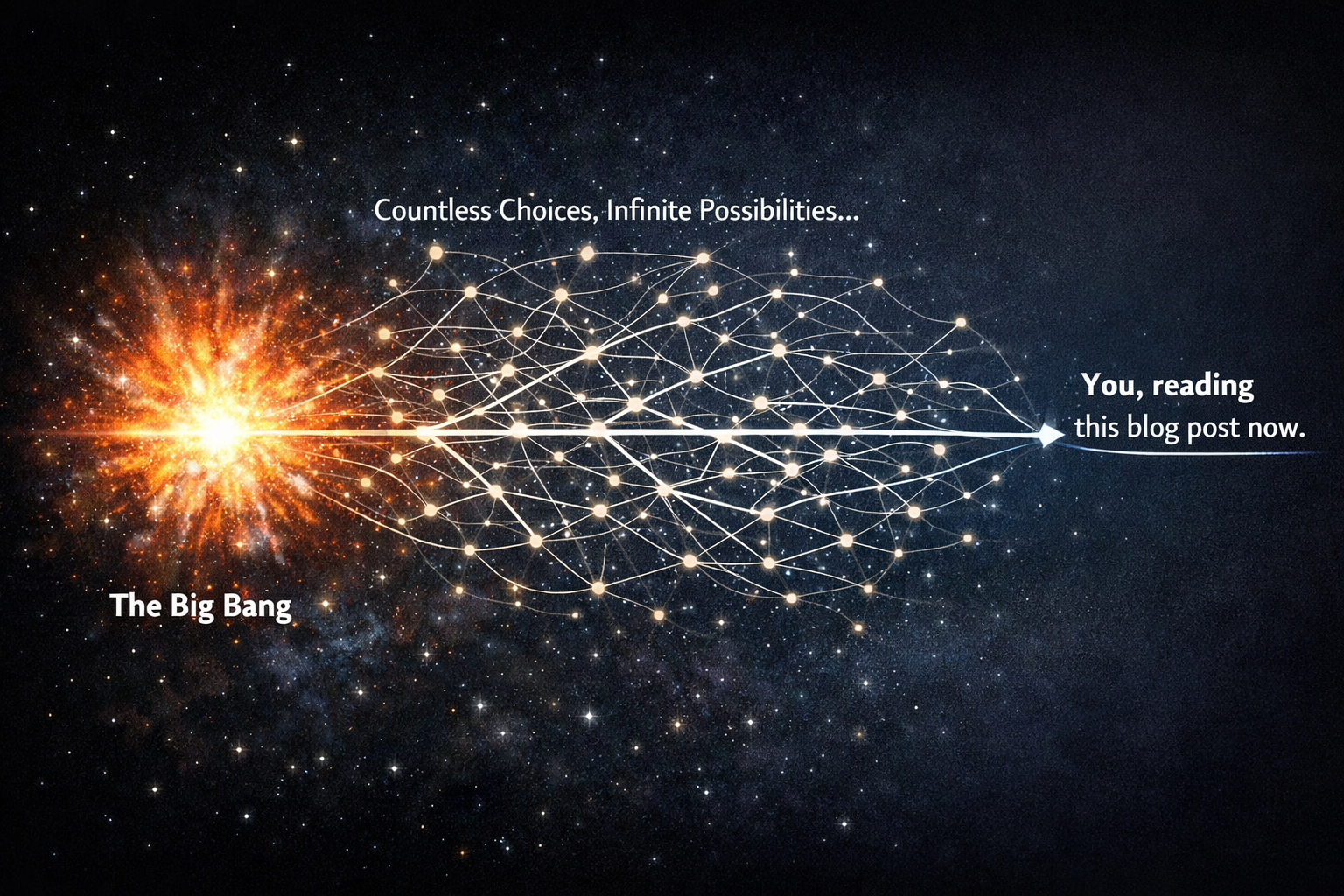
That'd be too easy of an explanation, unfortunately.
Such a demon could probably not exist. It is incompatible with the Copenhagen interpretation of quantum mechanics, because it stipulates that perfect knowledge is impossible in principle and that nature is probabilistic at its core, and Chaos theory challenges it by saying that deterministic systems are extremely sensitive to initial conditions (thus limiting the demon's capability in practice).
Second Act: Quantum mechanics is not your free escape
We have just established that some things out there do not seem to be truly deterministic, and that nature is, at least according to quantum mechanics, probabilistic. Maybe this proves that free will (can) exist(s)? But wait: randomness doesn't give you control. It just replaces "caused by prior events" with "not caused by anything in particular."
Neither the theory of Compatibilism (does not require the absence of determinism) nor Libertarian free will (requires indeterminism, but randomness is not enough - also requires agent-causation) equates randomness to free will.
In math-speak: Randomness is neither necessary nor sufficient for free will.
Randomness is not freedom. If your decision was partly the result of quantum indeterminacy - noise at the subatomic level - that doesn't make you more responsible for it. It makes you less. You didn't author the randomness. Nobody did. So we're left with the same conclusion: your choices are either determined by prior causes, or they're partly random. Neither of those is free will in any meaningful sense.
Third Act: My Claim...
a physical event, and
physical events are fully explained by
prior physical states, or,
probabilistic laws
then every decision is the result of processes outside the agent's
- your -
ultimate control.
Determinism removes alternative possibilities;
indeterminism introduces randomness,
which also does not constitute control.
In no case shall your will be free.
This stance assumes a physicalist view of the mind - if that fails, the conclusion may not hold. Also, for clarification, I am rejecting a specific, intuitive idea of free will - the idea that:
- you could have acted differently in exactly the same situation,
- and that you are the ultimate origin of your choices, independent of prior causes.
... and possible counterarguments:
You might not agree with me. And raise one of the following objections:
But... I feel free when I make decisions
Yes - and that feeling is real and important. But feeling free and being free in the metaphysical sense are different things. You feel the sun moving across the sky too. But it is the earth that rotates. Introspection is not a reliable guide to what's actually happening in your neurons. The experience of deliberation is genuine; what it means is the question.
But ... Quantum mechanics means it's not determined, so free will exists!
It is valid to say that an alternative reality might have existed [or, if you believe in the many-worlds interpretation, does exist] - but think about it - if the universe flipped a coin, does that really make you free? Free will requires that you are the origin of your choice - neither prior causes nor random noise qualifies.
But ... free will just means acting without coercion, no?
Compatibilism defines freedom of will in a way that makes responsibility, morality, and social systems actually work.
In its view, you are free when:
- your actions flow from your own internal states (beliefs, desires, reasoning),
- you can reflect on those states,
- and your behavior responds to reasons and consequences.
Why I still find this unsatisfying
I think this redefinition quietly changes the question.
When people ask whether they "could have done otherwise," they are not asking whether their actions were internally vs externally caused. They are asking whether, given the exact same conditions, a different outcome was genuinely possible.
Compatibilism answers a different question: "Was the action caused in the right way?"
But it leaves the original one untouched: "Could it have been otherwise?" If the answer is "no", then in what meaningful sense was the choice ever open?
So while compatibilism preserves a useful concept for responsibility, I don't think it captures the deeper intuition behind free will.
If you have another "Eh, wait" moment - write it into the comment, so I can edit this post and (try to) cover it 😄
Think of the last decision you made. Now trace it back. You chose based on your desires and values. But those desires came from your personality. Your personality came from your upbringing and experiences. Your experiences came from circumstances you didn't choose. Your brain chemistry - which shapes everything - was given to you by genetics and environment. At no point in that chain did you insert yourself from outside. You are the chain.
Fourth Act: So nothing matters?
The above could have come with a shocking realization for you, and I want to answer some of the most burning questions (at least they were for me).
"So decisions don't matter anymore?"
They still do - just not in the way you assume. A decision is still part of the causal chain of the universe. It still changes outcomes, still shapes lives, still produces consequences. Your choices are still the mechanism through which the future happens. They just aren't magically self-originating.
"So nobody is responsible for anything?"
That depends on your definition of responsibility.
If by responsibility you mean ultimate metaphysical authorship - the idea that someone could have stepped outside of everything that made them who they are and chosen differently - then yes, that kind of responsibility doesn't exist.
But that's not really useful, is it?
See responsibility as a tool: it describes how we respond to behavior within a system. We still distinguish between someone who understands harm and someone who doesn't, between someone who can change their behavior and someone who can't, between safety and risk.
Even in a deterministic world, feedback, consequences, learning, and adaptation are still real.
The absence of free will is not an excuse or an escape for problematic behavior.
"Then life is meaningless?"
I would argue that meaning in life comes from things like
- suffering vs. well-being
- relationships and attachment
- your goals
- curiosity, creation and understanding
- reducing harm, increasing stability and happiness
None of these require you being the "ultimate origin" of you choices. They depend on you being a system human experiencing and evaluating outcomes.
Even if your decisions are fully caused, they are still your decisions as they flow through your mind, reflect your preferences and shape your future experiences. Pain still hurts, and love still feels meaningful. Plans still succeed or fail, relative to what you care about.
Fifth Act: Shift Blame to Understanding
This has been one of my favorite quotes, and it remains to be:
“A man can do what he wills, but not will what he wills.”
– Arthur Schopenhauer
If I take this seriously, it changes how I see people. If a person’s will is shaped by causes they did not choose - upbringing, biology, past experiences, the situation they are in - then their actions start to look less like freely authored decisions and more like the outcome of a chain of influences. This way, a lot of their choices become "logical".
I’ve found myself shifting the question from “Why did they choose this?” to “What led them here?”. I am not saying I am always successful in this, and often it takes a discovery, or time (or both) for this to happen. It's a process much more than an immediate, "ready reaction".
This doesn’t mean I accept harmful behavior or drop my boundaries (and you shouldn't, either). It just changes what I’m reacting to. Instead of seeing someone as the ultimate source of what they did, I try to see them as a point where many causes come together.
And once I genuinely feel that, it becomes hard for me to stay truly angry at the person themselves. The anger, frustration or whatever feeling originates in that moment still comes up - even later - but it doesn't stick in the same way. It shifts away from the individual and toward the circumstances, the patterns, the underlying causes.
