

There are some other posts waiting to be published, but this one is something concerning a topic that has become increasingly difficult to deal with.
Since the rise of LLMs, especially the ones able to find security vulnerabilities in applications, self-hosting has become a bit of a nightmare. CVEs scoring 9 or higher are being dropped constantly, patches not always available.
Automate!
Privately, I run a cluster with 52+ applications, some of them exposed to the WWW. Yes, most of them are behind a middleware enforcing authentication before any traffic even reaches the service, but there are also some that don't have that for various reasons, for example because they are being accessed by (not-so-)Smart TVs, or lose their usefulness when their APIs are not directly exposed.
My cluster is managed by ArgoCD, and my applications are tracked in git. Whatever is tracked in my git, is deployed to my cluster - Argo is taking care of this. This makes deploying updates easy, and I tasked Renovate to keep my applications/helm charts up-to-date by automatically merging non-breaking updates.
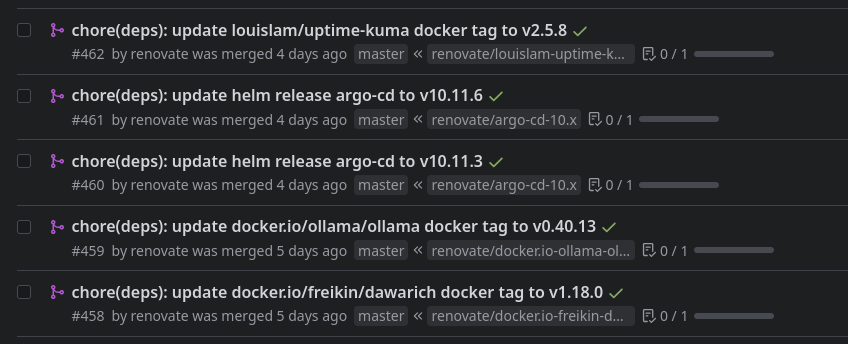
Four issues that hit hard these days:
Issue 1: Versioning, up to your interpretation
Some applications do not follow Semantic Versioning (i.e., the MAJOR.MINOR.PATCH versioning model), others use it as an "approximate guideline" (managing to break their application despite declaring they don't), some applications are stuck with the major version "0" (indicating that anything could break at any time in the future). It works well for most applications, but every now and then I still need to take care of updating them myself.
Issue 2: Poisoned updates
Unfortunately, another sort of attack has become increasingly common: It has become extremely attractive to compromise the accounts of authors of widely-used npm (JavaScript) packages - as soon as a developer installs an infected package, they’re compromised too. And now imagine you have Renovate (above) updating and installing things automatically. Uh-oh.
There have also been more sophisticated (attempted) attacks, like the backdoor on the compression software XZ Utils, present in many Linux systems. It was caught by accident because a developer noticed a performance drop in his SSH connections. So yeah, maybe you don't even want to update immediately?
Issue 3: Broken languages
Everyone noticed the wave of website outages a few weeks ago. PHP runs on roughly 70% of all web applications, and these days, you don't even have to have an affected application; it’s enough to run [insert programming language of your choice] when it’s affected.

The exploit leaked before patches were available / shipped, which is also not great either, almost forcing you to shut down your services until patches were made available.
Governments, universities and many hosting providers worldwide shut down their services and (hopefully) patched. Scarily enough, there’s also a number of (big) institutions that only updated their applications the next day or the day after. I noticed from their sudden 'emergency maintenance' emails… the day after.
Issue 4: Broken systems / kernels
And then there are the big ones, which don't even care about which system you run, merely the fact that you use Linux and have some application listening on a TCP port (your web server!) such as the recently dropped CVE-2026-98432 :/
 Atlas Security
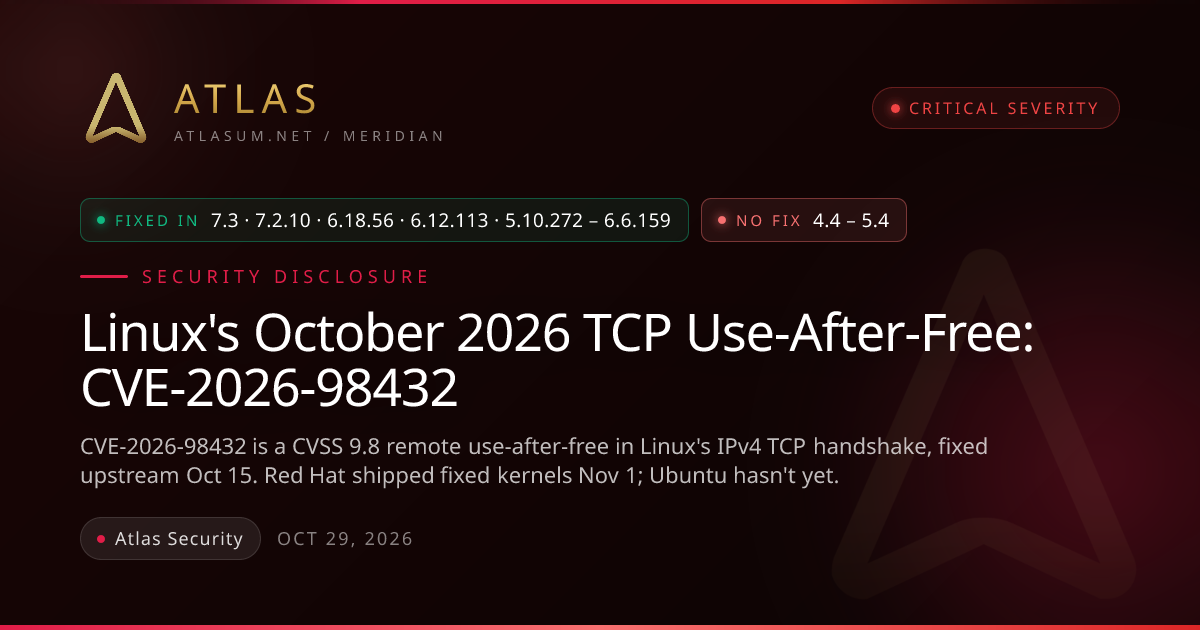
While most distributions are shipping their fixes already (update now!), the specialists at Canonical are not ... quite there yet:
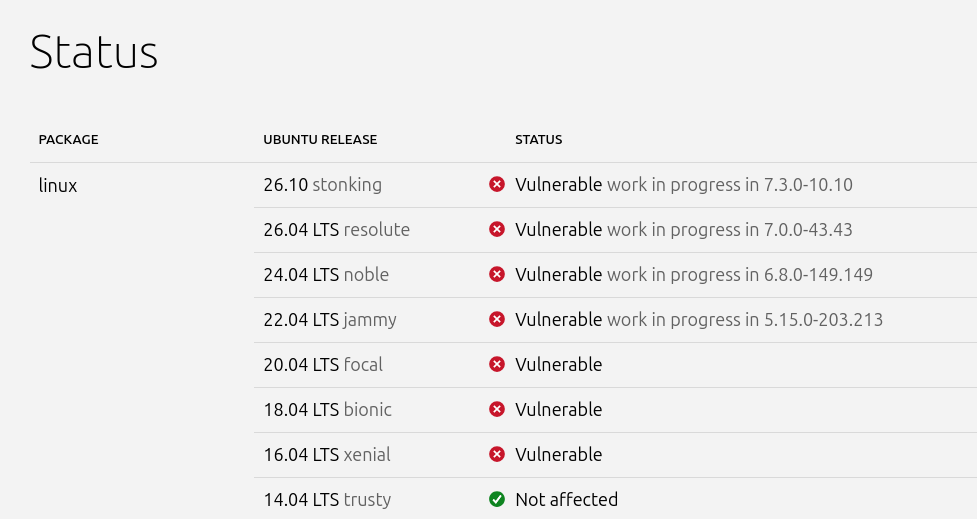
It's a good day to run Debian! ✨
Quo vadis?
I don't know if I still want to self-host if things continue like this. October has been a harsh month regarding vulnerabilities and I have constantly found myself updating dependencies, applications and kernels. I am self-hosting to learn, I am self-hosting to serve friends and family with awesome, de-googled applications and for the sake of it. But right now it feels like I am just running for one fix after the other. Sure, my private services are probably not interesting to any group out there, but then there's still a company cluster that faces exactly the same struggles; and there, it's not just some "self-hosting for fun", but actual customer data.
I am considering setting up an AI agent that indexes my cluster: which applications run in which versions, which languages and libraries they pull in, which kernels my nodes run. It would then watch vulnerability databases and advisories for anything matching that inventory. Most of the time it would just notify me, ideally with a short summary of whether the issue actually affects my setup or only looks scary on paper. For the truly critical cases, I’d like it to be able to take an exposed application offline until I’ve had a look. And yes, I’m aware of the irony: letting an AI loose on my cluster to protect me from vulnerabilities that AI helped find. How much I’d trust it to act on its own is something I haven’t figured out yet.
In this sense: Happy belated Halloween! As someone developing software and managing clusters, it's certainly been scary enough. If you have a good strategy, let me know in the comments.


